You booked the full set. You sat through two hours of careful application, walked out looking polished and put-together, and promised yourself you’d actually keep up with maintenance this time. Then life happened. Three and a half weeks passed, and now you’re looking in the mirror wondering whether what’s left on your lash line qualifies as a fill or a fresh start.
If that scenario sounds familiar, you’re not alone. Most people who get lash extensions understand the initial appointment well but have only a vague sense of what comes after. How often is often enough?
What does a fill actually involve? And what happens to your natural lashes if you keep pushing the schedule? This guide answers all of it. Ready to put what you learn to use? Book your lash extension appointment at Midlton Nails Studio and experience what consistent, expert maintenance actually looks like.
What Actually Happens to Your Lashes Between Appointments
The Natural Growth Cycle Behind the Shedding
Every natural lash you have is on its own independent growth cycle. That cycle has three phases: the anagen phase, when the lash is actively growing; the catagen phase, a short transitional window; and the telogen phase, when the lash rests and eventually sheds. The full cycle for a single eyelash takes anywhere from four to eleven months, and because each lash is at a different point in its cycle at any given moment, you shed individual lashes continuously rather than all at once. According to the American Academy of Dermatology, losing a few lashes per day is completely normal. It just becomes more visible once extensions are attached.
Lash extensions do not fall out because something went wrong. They fall out because the natural lash they are bonded to reached the end of its cycle. The extension goes with it. What remains on your lash line is always a mix of extensions at different stages: some fresh and close to the root, others grown out, others gone entirely.
What Shedding Looks Like on a Full Set
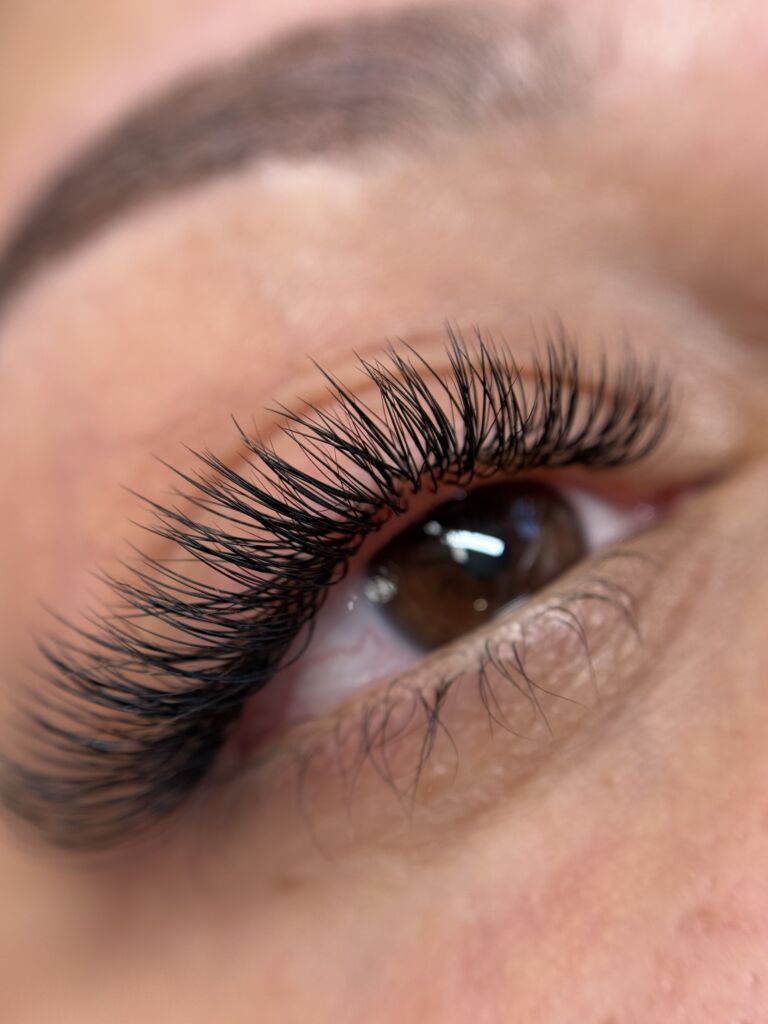
In the first week after a full set, most clients notice very little shedding. The extensions look dense and even because the majority of natural lashes were recently in or near the growth phase when the set was applied. By the end of the second week, gaps begin to appear – not uniformly, but scattered across the lash line as individual lashes hit their telogen phase. By three weeks, the patchiness becomes noticeable enough that most people feel self-conscious without mascara, which is not something you want to apply regularly to lash extensions.
What you are seeing is not the extensions failing. It is the natural cycle doing exactly what it is supposed to do. A fill appointment is simply the process of replacing what has shed and re-bonding anything that has grown significantly out from the root.
Why the Fill Window Is a Design Feature
The two to three week fill window maps directly to the rate at which natural lashes complete their cycles. Going in too early means your lash artist is working on a set that has not shed enough to make the appointment worthwhile. Going in too late means more extensions have shed than the fill timeframe allows for, and the appointment approaches the complexity and time cost of a full set. The window exists because it is the range where the work is genuinely efficient: enough has changed to warrant attention, not so much that you are essentially starting over.
How Often You Should Actually Be Booking Fills
The Two to Three Week Window
Most professional lash artists recommend fills every two to three weeks, and that range holds up across the industry. At the two-week mark, the average client has lost enough extensions to create visible gaps but still has a solid foundation of retained extensions to work from. The fill at this stage is efficient: the artist can isolate what has shed, assess what has grown out, and bring the set back to its original density in a fraction of the time a full set requires. At three weeks, the work takes longer and the cost may reflect that, but for clients whose lashes hold well, it is still a viable fill rather than a new set.
If you are not sure where you fall in that range, reach out to the team at Midlton Nails Studio before your appointment. A quick description of how your set looks at a given point tells your lash artist a lot about which end of the window is right for you.
Factors That Push You Toward Two Weeks
Several individual factors accelerate lash extension shedding. Oilier skin type is the biggest one: the natural oils your skin produces can break down lash adhesive faster than average, regardless of how carefully you follow aftercare instructions. An active lifestyle that involves frequent sweating has a similar effect, since moisture and heat both affect adhesive longevity. Oil-based products used anywhere near the eye area – including certain makeup removers and micellar waters – are another common culprit.
Sleeping face-down on a rough cotton pillowcase creates friction that physically loosens extensions over hundreds of hours. Summer heat and humidity, particularly relevant in New York, tend to shorten wear time for most clients compared to drier winter conditions.
What Lets You Stretch Comfortably to Three Weeks
Clients who can reliably go three weeks without a fill tend to share a few characteristics. Drier skin types generally retain extensions longer because there is less natural oil working against the adhesive. A consistent aftercare routine – particularly regular cleansing with a lash-safe foam wash – removes the buildup that gradually degrades the bond. Classic extensions and styles that use lighter-weight individual lashes put less mechanical stress on the natural lash, which means the bond holds longer before the lash cycle forces a shed. If you have been an extensions client for a while and your lashes have adapted to the consistent weight, retention often improves over time.
Fill vs. Full Set: How to Know Which One You Need
The 50 Percent Threshold
Most experienced lash artists work with a practical benchmark: if you arrive with less than roughly 50 percent of your extensions still attached, the appointment crosses from a fill into full-set territory in terms of time and labor. Below that threshold, the artist needs to apply so many new extensions that the time difference between a fill and a full set becomes marginal. A fill done on a set that is 70 percent intact takes perhaps an hour. A fill done on a set that is 30 percent intact takes close to the two-hour mark of a full set.
NAILS Magazine, the leading trade publication for nail and lash professionals, has noted that clear communication about fill thresholds is one of the most important elements of managing client expectations in the lash industry: it starts with clients understanding what the thresholds mean before they arrive.
Signs You Have Gone Past Fill Territory
There are a few clear signals that your set has gone too long for a fill to be practical. Visible gaps distributed across more than half the lash line – not just at the outer corners – suggest significant shedding. Extensions that sit noticeably far from the lash root indicate growth-out: the natural lash has continued its cycle while the bond has remained, meaning the extension is now at the mid-shaft or tip rather than at the root. If your lashes feel sparse even in the central part of the lid, that is a strong sign the set has thinned beyond fill range. When in doubt, send your lash artist a photo before your appointment. At Midlton Nails Studio, you can message us directly when you book so your artist knows exactly what to expect.
What Skipping Fills Costs Beyond the Aesthetic
The visible gaps are the obvious downside of waiting too long, but the less-discussed cost is what repeated overgrowth does to your natural lashes. When extensions grow significantly out from the root, they create a lever-like effect: the weight sits at a distance from where the lash anchors in the follicle, and every blink or brush adds mechanical stress to that anchor point. Over months, consistent overgrowth can contribute to natural lash thinning. Clients who maintain a regular fill schedule tend to see healthier, stronger natural lashes over time. The fill schedule is not just about how your extensions look. It is about protecting the natural lashes underneath.
How to Make Every Fill Last as Long as Possible
The First 24 to 48 Hours Are Everything
Lash adhesive cures over the 24 to 48 hours following your appointment, and what you do during that window has a disproportionate effect on how long your fill lasts. Avoiding water, steam, sweat, and humidity in the first 24 hours is the single most impactful aftercare step you can take – not because a small amount of water immediately destroys them, but because moisture during the curing window affects the adhesive at a molecular level and reduces its long-term bond strength. Skipping the gym, sauna, or hot shower for one day consistently adds days of wear time for most clients. After the curing window closes, gentle daily cleansing with a foam cleanser formulated for lash extensions removes the oils, makeup residue, and environmental buildup that accumulate at the base of the extensions and slowly degrade the bond.
Lifestyle Habits That Accelerate Shedding
Beyond the curing window, several everyday habits measurably affect how long your fill lasts. Oil-based products anywhere near the eye area are the most common offender: some makeup removers, certain moisturizers applied too close to the lash line, and oil-based eye serums. The FDA’s cosmetics guidance classifies lash adhesives as cosmetic products, and like all cosmetics, their performance is affected by the chemical environment they are used in.
Sleeping on a rough cotton pillowcase creates ongoing friction against your extensions throughout the night – switching to a silk or satin pillowcase is a small change that many regular extensions clients find genuinely extends their wear time. Touching or rubbing your eyes loosens individual bonds incrementally. And applying mascara to lash extensions creates residue buildup at the bond site that weakens the adhesive and causes clumping.
What to Tell Your Lash Artist at Every Fill
The more information your lash artist has at a fill appointment, the better they can adapt the service to your actual needs. Tell them specifically where on your lash line you have lost the most makeup routine since your last appointment, because formula changes often explain sudden shifts in retention. If you want any adjustment to the style, a fill is the right time to communicate that. And if
you have experienced any redness, itching, or unusual sensitivity around your eyes, mention it before the appointment starts.
The American Academy of Dermatology notes that contact sensitization to adhesive ingredients can develop over time even in clients who have had no prior reactions – catching it early protects both your eyes and your natural lashes.
When your lash artist understands your history, your habits, and your goals, the fill appointment stops being a routine touchup and becomes a genuinely personalized service. That is the standard we hold ourselves to at Midlton Nails Studio – book your fill and experience the difference that attentive, knowledgeable care makes.
Conclusion
Lash extension fills are not maintenance for maintenance’s sake. They are the system that makes the investment in a full set pay off – for your appearance, your budget, and the long-term health of your natural lashes. Understanding the biology behind the two to three week window, the logic behind fill versus full-set thresholds, and the specific habits that either extend or shorten your wear time puts you in control of your results in a way that no amount of hoping or guessing can match.
The clients who get the most consistent, beautiful results from their lash extensions are the ones who show up on schedule, communicate honestly with their artist, and take their aftercare routine seriously. None of that is complicated. It just requires knowing what you are working with. If you are ready to build a lash maintenance routine that fits your lifestyle and keeps your extensions looking their best, visit Midlton Nails Studio and book your fill appointment today. Our lash artists are here to work with your schedule, your lashes, and your goal every single time.
FAQ
1. How long does a lash fill appointment take compared to a full set?
A fill on a well-maintained set – coming in at the two to three week mark with 50 percent or more of extensions still intact – typically takes between 45 minutes and an hour and a half, depending on the density and style of your set. A full set generally takes two to two and a half hours. If you arrive with significant shedding beyond the fill threshold, your artist may need to treat the appointment as a full set in terms of time and pricing, which is why staying on schedule matters. Book at Midlton Nails Studio and we will confirm the appointment length based on your specific set.
2. Can I get a fill if I only have a few extensions left?
Technically yes, but in practice it may not be the most cost-effective choice. If fewer than roughly half your extensions remain, most artists will recommend a full set – both because the result will look better and because the time involved is nearly the same. A sparse fill on top of a heavily shed set tends to look uneven because the new extensions stand out against the near-bare natural lashes. Starting fresh gives a more consistent, polished result and a better foundation for your next fill cycle.
3. Do I need to do anything to prepare for a fill appointment?
Coming in with clean lashes is the most important thing. Residue from makeup, skincare products, or sunscreen at the lash base makes it harder for your artist to properly assess the set and apply new extensions cleanly. Remove any eye makeup before your appointment and avoid applying heavy moisturizer or oil-based products near your eyes on the day of your visit. Avoiding caffeine before appointments can also help if you are prone to eye twitching.
4. Is it normal to shed more extensions at certain times of year?
Yes, and it is not just anecdotal. Seasonal shifts affect the natural lash growth cycle, with many clients noticing accelerated shedding in spring and fall. Humidity changes in summer can also affect adhesive longevity. If you find your fills are wearing shorter in certain seasons, it is worth scheduling slightly more frequently during those windows rather than waiting for visible gaps to appear. Talk to our team at Midlton Nails Studio about adjusting your schedule seasonally – it is one of the easiest ways to maintain consistent results year-round.
5. What happens if I regularly wait longer than three weeks between fills?
In the short term, you will need full-set appointments more often because your sets will cross the fill threshold before you come in. Over the longer term, consistently allowing extensions to grow out significantly can add mechanical stress to the natural lash follicle, which some clients experience as gradual thinning of their natural lashes. Regular, scheduled fills are the most practical way to protect both the appearance and the condition of your lashes. Book your next fill at Midlton Nails Studio and let us help you find the schedule that works best for you.